5-minute read

Tesla may be best known for its electric cars, but its long-term ambitions extend far beyond the automotive industry. Across autonomous driving, artificial intelligence, robotics, and energy, Tesla is positioning itself at the center of technologies that could reshape how people live, work, and interact with the world.
Below are five key themes behind Tesla’s long-term opportunities:
1. The Robotaxi Revolution
Tesla is developing Full Self-Driving (FSD) technology aimed at enabling autonomous robotaxis. The company has already begun testing ride-hailing services in Austin and San Francisco, with plans to expand rapidly.
If this technology scales, it could fundamentally change how vehicles are used - shifting from owned vehicles to on-demand transportation services. ARK Invest estimates the global robotaxi opportunity could reach up to $10 trillion by 2030.1
1 Ark Invest
2. Tesla’s Real-World AI Advantage
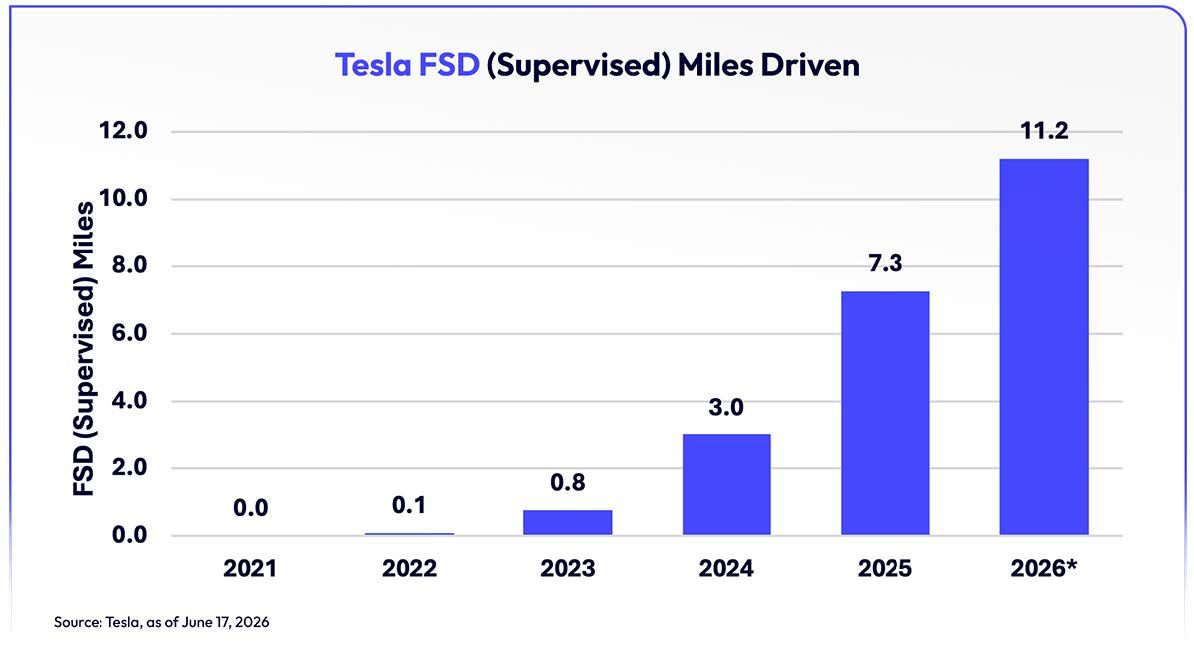
Tesla’s approach to AI is built on real-world data at scale. To date, Tesla vehicles have driven over 11 billion miles using FSD (Supervised), generating data from real-world driving conditions. Beyond vehicles, Elon Musk’s AI company xAI develops models like Grok, integrated into X (formerly Twitter), a platform with over 500 million users globally.2
This creates a feedback loop:
More Real-World Usage → More Data → Better AI → Improved Performance
The combination of physical-world data and large-scale human interaction may help Tesla better address edge cases, including unpredictable scenarios and human behavior.
3. Optimus and the Robotics Opportunity
Tesla is developing Optimus, a humanoid robot designed to perform everyday tasks. The company expects initial deployments in factories and warehouses, where robots could help automate repetitive and labor-intensive work. Over time, the vision expands to broader applications, including logistics and even household applications such as cleaning, cooking, and childcare. Elon Musk has suggested that one day, each family could have an Optimus, and has stated:
“Optimus has the potential to be more significant than [Tesla’s] vehicle business over time.”3
This vision may not be too far away, as Tesla plans to start production of Optimus before the end of 2026.
Want Exposure to TSLA With the Potential for Daily Income? |
The xETFs TSLA Daily Income ETF (TYYY) is designed to provide long exposure to TSLA while seeking to generate daily potential income through a systematic daily options strategy. The fund seeks to retain the majority of Tesla's upside, with the goal of providing both equity participation and income generation from one of the market's most closely watched stocks.Learn more at xETFs.com/TYYY |
2 Monthly Active Users (MAU), as of July 2025. Source: Quantumrun Foresight
3 Tesla, CNBC
4. EVs and Energy Still Power the Business
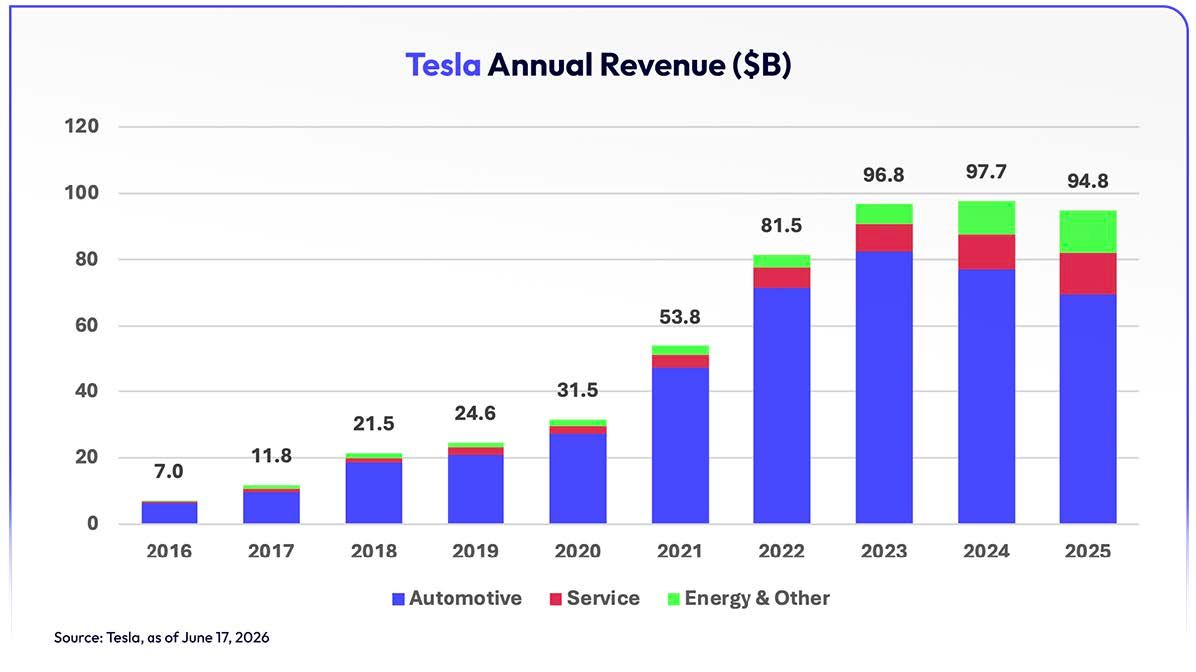
While Tesla is investing in new technologies, its core business remains electric vehicles and energy today. In 2025, Tesla delivered over 1.6 million vehicles globally, generating nearly $70 billion in automotive revenue.4
At the same time, Tesla is expanding its energy generation and storage business, deploying 46.7 GWh of battery storage through products like Megapack and Powerwall. The energy segment has become one of Tesla’s fastest-growing businesses, with revenue reaching approximately $13 billion in 2025.5
These businesses provide the scale and cash flow that support Tesla’s longer-term initiatives.
4 Tesla
5 Tesla
5. The Elon Musk Ecosystem
Tesla operates within a broader network of companies led by Elon Musk, each focused on major technological shifts.
Tesla → EVs, autonomy, robotics, energy
SpaceX → reusable rockets and the Starlink satellite network
xAI → artificial intelligence models such as Grok, integrated into X
Together, these companies reflect a shared focus on AI, infrastructure, and complex systems. They provide exposure to both physical-world data and large-scale user interaction, which may help accelerate the development of technologies across the ecosystem.
The Opportunity Ahead
Tesla is investing across a range of technologies that have the potential to reshape everyday life and the way people work and live. From autonomous driving to artificial intelligence to robotics, these areas represent some of the most significant technological shifts underway.
Supporting these efforts is Tesla’s existing EV and energy business, which provides the foundation to invest in and develop these opportunities at scale.
For investors, owning Tesla today is not just about its current operations - it is also a bet on how these technologies may evolve in the future and the role Tesla could play in shaping how we live, work, and interact with the world.
Investing in Tesla? There may be a way to do it with daily potential income.
For investors seeking exposure to Tesla alongside daily potential income, the xETFs TSLA Daily Income ETF (TYYY) is designed to provide long exposure to TSLA while seeking to generate daily potential income through a systematic daily options strategy. The fund seeks to retain the majority of Tesla's upside, with the goal of providing both equity participation and income generation from one of the market's most closely watched stocks, with weekly distributions.
All fund materials, including the prospectus, are available at xETFs.com/investor-materials.
TYYY Disclosures
There is no guarantee that the Fund’s investment strategy will be properly implemented, and an investor may lose some or all of its investment. There is no guarantee that the Fund will be successful in its attempt to pay weekly distributions or consistent exposure to TSLA. An investment in the Fund is not an investment in TSLA. The Fund’s strategy will not capture all potential gains if TSLA’s share price increases in value. The Fund’s strategy is subject to all potential losses if TSLA’s share price decreases in value, which may not be offset by premium income received by the Fund.
Covered Call Strategy Risk. A covered call strategy involves writing (selling) covered call options in return for the receipt of premiums. By employing this strategy, each Fund’s upside participation is capped, meaning investors will not benefit from increases in the underlying reference asset above the exercise price of the options. However, investors remain exposed to the full downside risk, as the Fund continues to bear the risk of underlying reference asset price declines. The premiums received from the options may not be sufficient to offset any losses sustained from underlying reference asset price declines over time. In rapidly rising markets, the Fund may significantly underperform the underlying reference asset, as gains above the exercise price are forfeited. As a result, the risks associated with writing covered call options may be similar to the risks associated with writing put options. Exchanges may suspend the trading of options during periods of abnormal market volatility. Suspension of trading may mean that an option seller is unable to sell options at a time that may be desirable or advantageous to do so.
Derivatives Risk. The use of derivative instruments involves risks different from, or possibly greater than, the risks associated with investing directly in securities and other traditional investments. These risks include: (I) the risk that the counterparty to a derivative transaction may not fulfill its contractual obligations; (ii) risk of mispricing or improper valuation; and (iii) the risk that changes in the value of the derivative may not correlate perfectly with the underlying asset. Derivative prices are highly volatile and may fluctuate substantially during a short period of time. Such prices are influenced by numerous factors that affect the markets, including, but not limited to: changing supply and demand relationships; government programs and policies; national and international political and economic events, changes in interest rates, inflation and deflation and changes in supply and demand relationships. Trading derivative instruments involves risks different from, or possibly greater than, the risks associated with investing directly in securities. Derivative contracts ordinarily have leverage inherent in their terms. The low margin deposits normally required in trading derivatives, including futures contracts, permit a high degree of leverage. Accordingly, a relatively small price movement may result in an immediate and substantial loss. The use of leverage may also cause the Fund to liquidate portfolio positions when it would not be advantageous to do so in order to satisfy its obligations or to meet collateral segregation requirements. The use of leveraged derivatives can magnify potential for gain or loss and, therefore, amplify the effects of market volatility on share price.
Distribution Tax Risk. The Fund currently expects to make distributions on a weekly basis. Such frequent distributions may expose investors to increased tax liabilities. However, these distributions may exceed the Fund’s income and gains for the Fund’s taxable year. Distributions in excess of the Fund’s current and accumulated earnings and profits will be treated as a return of capital. A return of capital distribution generally will not be taxable currently but will reduce the shareholder’s cost basis and will result in a higher capital gain or lower capital loss when those Fund Shares on which the distribution was received are sold.
Options Risk. The use of options involves investment strategies and risks different from those associated with ordinary portfolio securities transactions and depends on the ability of the Fund’s portfolio managers to forecast market movements correctly. The prices of options are influenced by, among other things, actual and anticipated changes in the value of the underlying instrument, or in interest or currency exchange rates, including the anticipated volatility, which in turn are affected by fiscal and monetary policies and by national and international political and economic events. As a seller (writer) of a put option, the Fund will lose money if the value of the reference index or security falls below the strike price and the buyer exercises the option; however, such loss will be partially offset by any premium received from the sale of the option. As the seller (writer) of a call option, the Fund will lose money if the value of the reference index or security rises above the strike price and the buyer exercises the option; however, such loss will be partially offset by any premium received from the sale of the option. As the buyer of a put or call option, the buyer risks losing the entire premium invested in the option if the buyer does not exercise the option. The effective use of options also depends on the Fund’s ability to terminate option positions at times deemed desirable to do so. There is no assurance that the Fund will be able to effect closing transactions at any particular time or at an acceptable price. In addition, there may at times be an imperfect correlation between the movement in values of options and their underlying securities and there may at times not be a liquid secondary market for certain options. Options may also involve the use of leverage, which could result in greater price volatility than other securities.
There is no guarantee that the Fund will be successful in its attempt to pay weekly distributions, which are not guaranteed and may be modified or discontinued at any time. A distribution may consist of a return of capital, ordinary income, qualified dividend income, and /or capital gains. A return of capital is a distribution that exceeds the Fund’s current and accumulated earnings and profits and is not taxable as current income. Instead, it reduces an investor’s tax basis in their shares and may result in a higher capital gain or lower capital loss when the shares are sold.
There is no guarantee that the Fund’s investment strategy will be properly implemented, and an investor may lose some or all of its investment. There is no guarantee that the Fund will be successful in its attempt to pay weekly distributions or consistent exposure to NVDA or TSLA. An investment in the Fund is not an investment in NVDA or TSLA. The Fund’s strategy will not capture all potential gains if NVDA’s or TSLA’s share price increases in value. The Fund’s strategy is subject to all potential losses if NVDA’s or TSLA’s share price decreases in value, which may not be offset by premium income received by the Fund.
Carefully consider the Funds’ investment objectives, risk factors, charges and expenses before investing. This and additional information can be found in the Funds’ Prospectus and Summary Prospectus, which may be obtained by visiting https://funds.xETFs.com/investor-materials. Read the Prospectus and Summary Prospectus carefully before investing.
Exchange Traded Concepts, LLC serves as the investment adviser. WallStreetX ETFs, Inc. dba xETFs serves as the sub-adviser. The Funds are distributed by Foreside Fund Services, LLC., which is not affiliated with xETFs, Exchange Traded Concepts, LLC, or any of its affiliates.
Investing involves risk, including possible loss of principal. The Fund’s return may not match or achieve a high degree of correlation with the return of the Index. To the extent the Fund’s investments are concentrated in or have significant exposure to a particular issuer, industry or group of industries, or asset class, the Fund may be more vulnerable to adverse events affecting such issuer, industry or group of industries, or asset class than if the Fund’s investments were more broadly diversified. Issuer-specific events, including changes in the financial condition of an issuer, can have a negative impact on the value of the Fund.
A new or smaller fund is subject to the risk that its performance may not represent how the fund is expected to or may perform in the long term. In addition, new funds have limited operating histories for investors to evaluate and new and smaller funds may not attract sufficient assets to achieve investment and trading efficiencies.
Shares are bought and sold at market price (closing price) not net asset value (NAV) and are not individually redeemed from the Fund. Market price returns are based on the midpoint of the bid/ask spread at 4:00pm Eastern Time (when NAV is normally determined) and do not represent the return you would receive if you traded at other times. Brokerage commissions will reduce returns.