
Artificial intelligence is usually discussed in terms of models and compute. But the harder problem is physical. Before a model can be trained or served, someone has to build the facility that runs it, secure the power to feed it, and manufacture the memory, optics, and silicon inside it. Each of those can carry a lead time, sometimes measured in years.
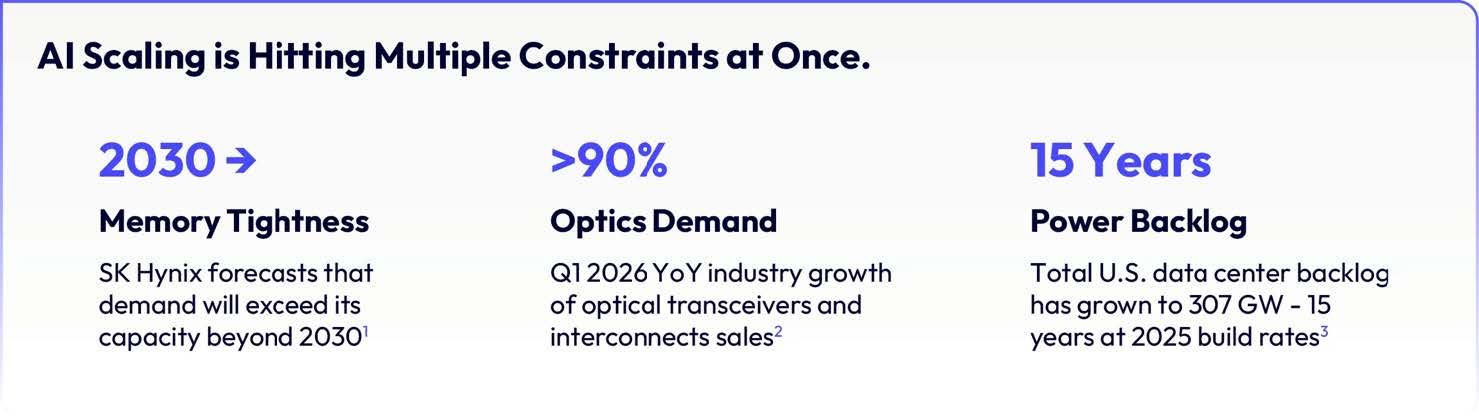
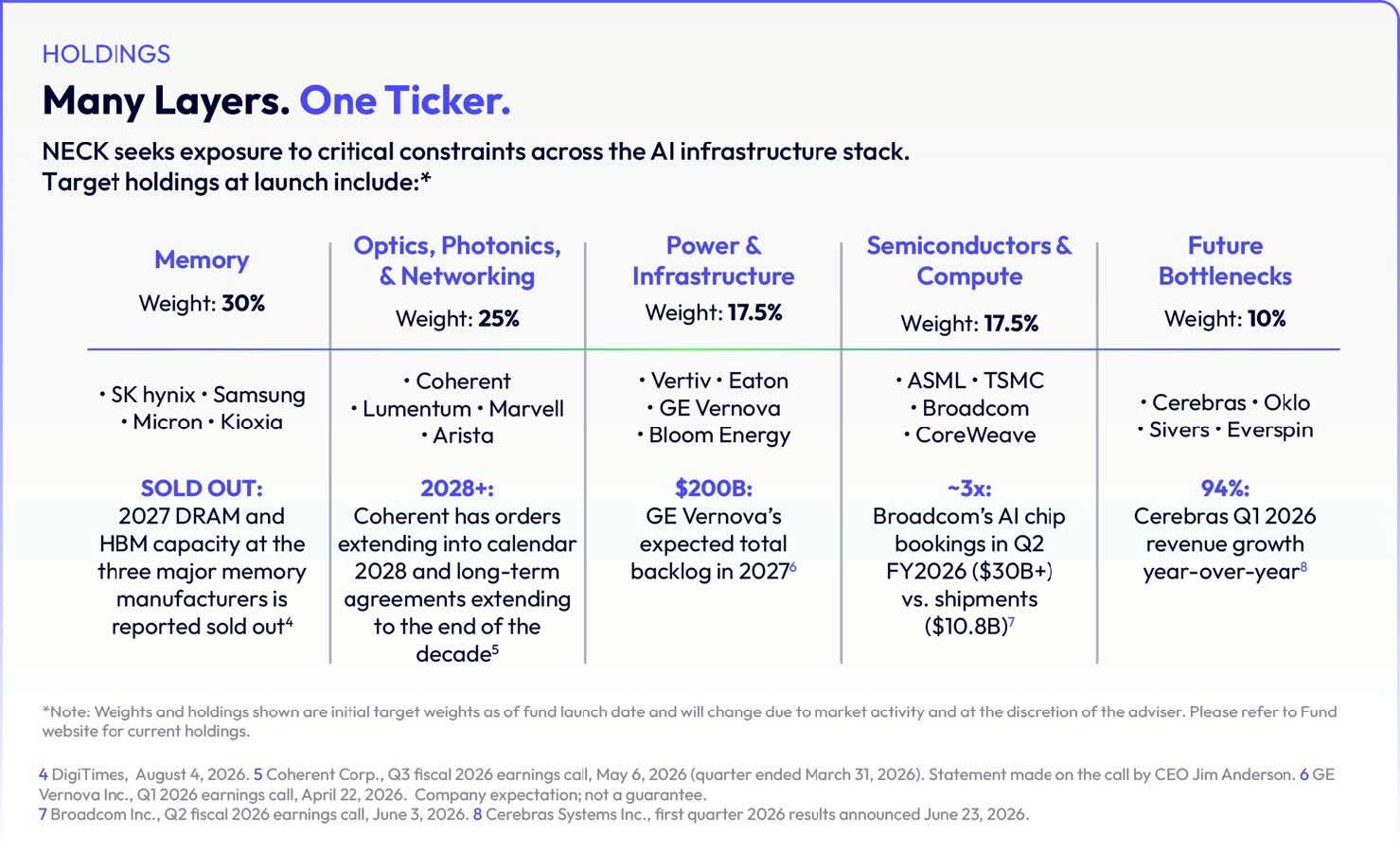
The scale is easiest to see in electricity. On its second quarter 2026 earnings call, Eaton put the U.S. data center industry backlog at 307 gigawatts, roughly 15 years of construction at 2025 build rates.1 In April 2026, GE Vernova told investors it expects its power equipment and services backlog to reach $200 billion in 2027, a year earlier than it had previously indicated.2
Figures like those describe an industrial program rather than a product cycle. Capacity arrives when the slowest input catches up.
Bottlenecks Defined
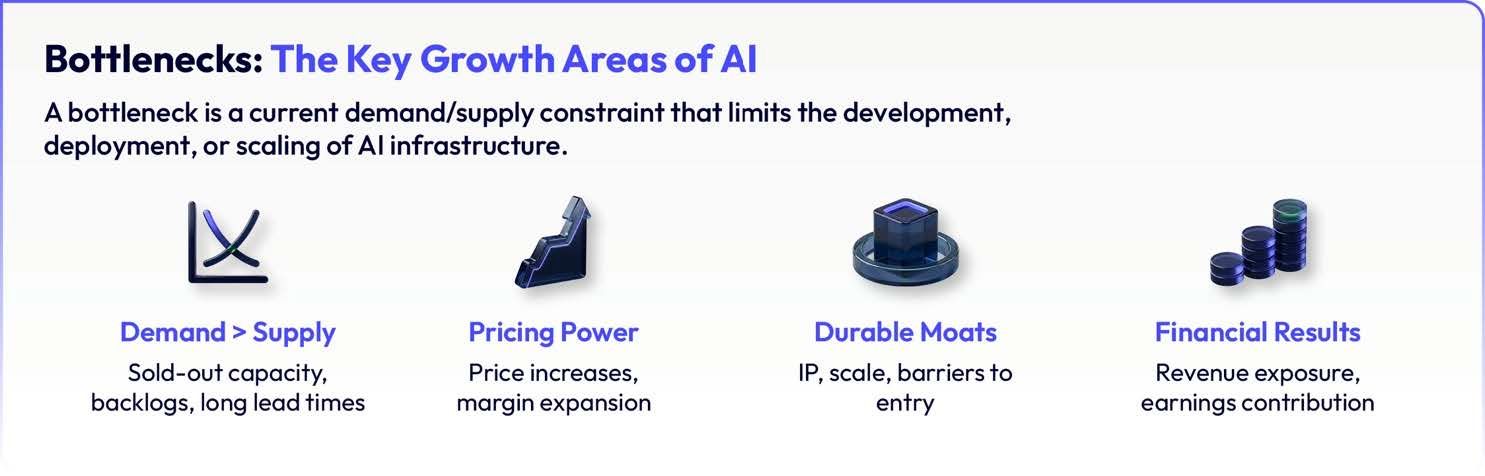
In any large construction program, output is governed by the scarcest component rather than the most abundant one. AI infrastructure works the same way, and that is where the investment question narrows. Capital spending is broad, but the leverage concentrates in specific places.
A bottleneck is a current demand and supply constraint that limits the development, deployment, or scaling of AI infrastructure; it reflects today’s shortage.
Where We Believe the Constraints Are Today
Memory. Training and serving large models requires moving enormous volumes of data between memory and processors. When memory cannot keep up, the processor waits. That has made high bandwidth memory one of the scarcest inputs in the buildout. In July 2026, SK Hynix CEO Kwak Noh-Jung said, “We still forecast that customer demand will remain higher than our supply capacity even beyond 2030.”3
Optics and networking. Data that leaves one chip has to reach the next. As AI scales, that traffic increasingly moves optically instead of across wires. Sales of optical transceivers and active optical cables were estimated at approximately $10 billion in the first quarter of 2026, more than 90% higher than a year earlier.4
Compute. Orders for AI silicon have been running ahead of what suppliers can deliver. On its second quarter fiscal 2026 earnings call, Broadcom reported more than $30 billion of AI semiconductor bookings against $10.8 billion shipped in the quarter.5
Constraints Can Be Temporary
When a company holds a constraint, it shows up in the numbers: backlogs grow, lead times stretch, and prices rise. That makes future revenue easier to count on.
But that position isn't permanent. Constraints shift as new capacity comes online, substitutes emerge, and spending priorities change. A company that's supply-constrained today may not be tomorrow, so a portfolio built around these companies needs to be able to shift with them.
Introducing NECK
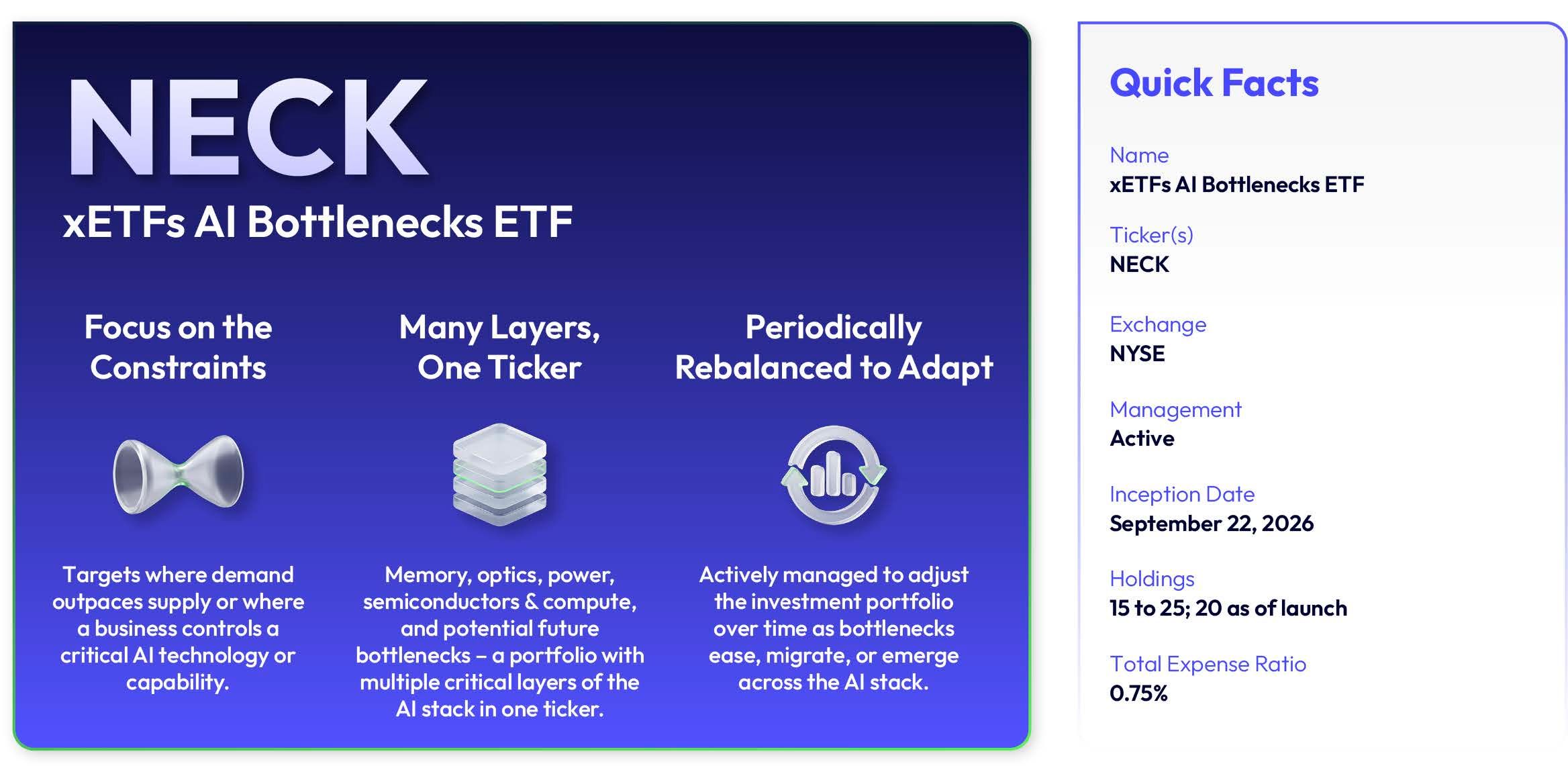
The xETFs AI Bottlenecks ETF (NECK) is an actively managed ETF that seeks to invest in companies we believe are positioned at critical points of constraint across the AI stack, all through a single ticker. Rather than focusing only on the biggest AI companies, NECK looks across the infrastructure required to build and scale AI for areas where demand may be growing faster than supply or where companies hold critical strategic positions.
The portfolio is expected to generally include between 15 to 25 companies globally.
As bottlenecks ease, migrate, or emerge across the AI stack, the Fund expects to periodically rebalance its investments to reflect changing market conditions.
Targeting AI’s Critical Constraints.
Broad AI exposure tends to concentrate in the same handful of names. NECK is built around a different question: what companies supply the critical inputs that AI cannot scale without?
Learn more and view the prospectus at www.xETFs.com/NECK
Sources
1 Eaton Corporation plc management, Q2 2026 earnings call, July 31, 2026.
2 GE Vernova Inc., Q1 2026 earnings call, April 22, 2026.
3 SK hynix CEO Kwak Noh-Jung, quoted by Reuters, July 10, 2026. Company forecast; not a guarantee of future results.
4 LightCounting Research, Quarterly Market Update, June 2026. 5 Broadcom Inc., Q2 fiscal 2026 earnings call, June 3, 2026.
NECK Disclosures
AI Bottlenecks Companies Risk. The xETFs AI Bottlenecks ETF invests in AI Bottleneck Companies which provide products, technologies or services critical to the development, deployment or scaling of AI, including memory; optics, photonics and networking; power and infrastructure; semiconductors and compute; and other AI infrastructure bottlenecks. These companies may be highly dependent on the continued growth of AI-related spending, infrastructure demand and commercialization. If AI adoption, investment or monetization is slower than expected, or demand for AI-related infrastructure is overestimated, the securities of these companies may experience significant declines. Companies exposed to AI bottlenecks may be subject to rapid technological change, intense competition, short product cycles, supply and demand imbalances, component shortages, manufacturing constraints, customer concentration, and significant development and capital requirements. Their businesses may also be adversely affected by export controls, trade restrictions, intellectual property disputes, cybersecurity incidents, energy constraints, geopolitical tensions, and disruptions in key technology supply chains. A company identified as addressing an AI bottleneck may lose that position as technology evolves, competitors enter the market, production capacity expands, or alternative technologies reduce the need for its products or services. There can be no assurance that any identified bottleneck will result in increased revenues, margins, pricing power, or stock price appreciation for those companies. Bottlenecks may prove temporary, may be resolved more quickly than expected, or may shift to other parts of the AI stack as technology evolves, competitors enter the market, production capacity expands, or alternative technologies reduce the need for a company’s products or services.
Asia Risk. The Funds may invest significantly in the securities of Asian issuers. As such, each Fund is subject to certain risks specifically associated with investments in the securities of Asian issuers. Many Asian economies have experienced rapid growth and industrialization, and there is no assurance that this growth rate will be maintained. Some Asian economies are highly dependent on trade, and economic conditions in other countries within and outside Asia can impact these economies. Certain of these economies may be adversely affected by trade or policy disputes with its major trade partners. There is also a high concentration of market capitalization and trading volume in a small number of issuers representing a limited number of industries, as well as a high concentration of investors and financial intermediaries. Certain Asian countries have experienced and may in the future experience expropriation and nationalization of assets, confiscatory taxation, currency manipulation, political instability, armed conflict and social instability as a result of religious, ethnic, socio-economic and/or political unrest. In particular, escalated tensions involving North Korea and any outbreak of hostilities involving North Korea could have a severe adverse effect on Asian economies. Governments of certain Asian countries have exercised, and continue to exercise, substantial influence over many aspects of the private sector. In certain cases, the government owns or controls many companies, including the largest in the country. Accordingly, government actions could have a significant effect on the issuers of each Fund’s securities or on economic conditions generally. Recent developments in relations between the U.S. and China have heightened concerns of increased tariffs and restrictions on trade between the two countries. An increase in tariffs or trade restrictions, or even the threat of such developments, could lead to a significant reduction in international trade, which could have a negative impact on the economy of Asian countries and a commensurately negative impact on the Funds.
Concentration Risk. Each Fund is susceptible to an increased risk of loss, including losses due to adverse events that affect its investments more than the market as a whole, to the extent that its investments are concentrated in the securities and/or other assets of a particular issuer or issuers, country, group of countries, region, market, industry, group of industries, sector, market segment or asset class.
Depositary Receipts Risk. Each Fund may invest in depositary receipts. Investment in ADRs and GDRs may be less liquid than the underlying shares in their primary trading market and GDRs, many of which are issued by companies in emerging markets, may be more volatile and less liquid than depositary receipts issued by companies in more developed markets.
Derivatives Risk. The use of derivative instruments involves risks different from, or possibly greater than, the risks associated with investing directly in securities and other traditional investments. These risks include: (I) the risk that the counterparty to a derivative transaction may not fulfill its contractual obligations; (ii) risk of mispricing or improper valuation; and (iii) the risk that changes in the value of the derivative may not correlate perfectly with the underlying asset. Derivative prices are highly volatile and may fluctuate substantially during a short period of time.
Foreign Securities Risk. Foreign Securities Risk. Investments in non-U.S. securities involve certain risks that may not be present with investments in U.S. securities. For example, investments in non-U.S. securities may be subject to risk of loss due to foreign currency fluctuations or to expropriation, nationalization or adverse political or economic developments. Foreign securities may have relatively low market liquidity and decreased publicly available information about issuers. Investments in non-U.S. securities also may be subject to withholding or other taxes and may be subject to additional trading, settlement, custodial, and operational risks. Non-U.S. issuers may also be subject to inconsistent and potentially less stringent accounting, auditing, financial reporting and investor protection standards than U.S. issuers. These and other factors can make investments in the Funds more volatile and potentially less liquid than other types of investments. In addition, where all or a portion of a Fund’s portfolio holdings trade in markets that are closed when the Fund’s market is open, there may be valuation differences that could lead to differences between the Fund’s market price and the value of the Fund’s portfolio holdings.
Geographic Investment Risk. To the extent a Fund invests a significant portion of its assets in the securities of companies of a single country or region, it is more likely to be impacted by events or conditions affecting that country or region. The country or region in which a Fund invests may have experienced security concerns, war or threats of war and aggression, terrorism, economic uncertainty, natural and environmental disasters and/or systemic market dislocations that have led, and in the future may lead, to increased short-term market volatility, each of which may impact the Fund’s investments.
Semiconductor Companies Risk. The semiconductor industry is characterized by rapid technological change and product obsolescence, cyclical market patterns, price erosion, periods of over-capacity and production shortages, variations in manufacturing costs and yields, and significant expenditures for capital equipment and product development. Semiconductor companies depend significantly on third-party suppliers and the availability of raw materials and may be adversely affected by supply chain disruptions. They also may be adversely affected by the loss or impairment of intellectual property rights.
Small Capitalization Companies Risk. Small capitalization companies may be more vulnerable to adverse general market or economic developments, and their securities may be less liquid and may experience greater price volatility than large and mid capitalization companies as a result of several factors, including limited trading volumes, fewer products or financial resources, management inexperience and less publicly available information. Accordingly, such companies are generally subject to greater market risk than large and mid capitalization companies.
Carefully consider the Funds’ investment objectives, risk factors, charges and expenses before investing. This and additional information can be found in the Funds’ Prospectus and Summary Prospectus, which may be obtained by visiting https://funds.xETFs.com/investor-materials. Read the Prospectus and Summary Prospectus carefully before investing.
Exchange Traded Concepts, LLC serves as the investment adviser. WallStreetX ETFs, Inc. dba xETFs serves as the sub-adviser. The Funds are distributed by Foreside Fund Services, LLC., which is not affiliated with xETFs, Exchange Traded Concepts, LLC, or any of its affiliates.
Investing involves risk, including possible loss of principal. The Fund’s return may not match or achieve a high degree of correlation with the return of the Index. To the extent the Fund’s investments are concentrated in or have significant exposure to a particular issuer, industry or group of industries, or asset class, the Fund may be more vulnerable to adverse events affecting such issuer, industry or group of industries, or asset class than if the Fund’s investments were more broadly diversified. Issuer-specific events, including changes in the financial condition of an issuer, can have a negative impact on the value of the Fund.
A new or smaller fund is subject to the risk that its performance may not represent how the fund is expected to or may perform in the long term. In addition, new funds have limited operating histories for investors to evaluate and new and smaller funds may not attract sufficient assets to achieve investment and trading efficiencies.
Shares are bought and sold at market price (closing price) not net asset value (NAV) and are not individually redeemed from the Fund. Market price returns are based on the midpoint of the bid/ask spread at 4:00pm Eastern Time (when NAV is normally determined) and do not represent the return you would receive if you traded at other times. Brokerage commissions will reduce returns.